
By Drake Miller – Senior Content Manager & Higher Education Strategist
The transition to higher education in Australia represents more than just a change in curriculum; it is a fundamental shift in lifestyle. Whether you are navigating the final hurdles of the Victorian Certificate of Education (VCE), the HSC in New South Wales, or settling into the lecture theatres of the University of Melbourne, USYD, or ANU, the environment demands a level of autonomy previously unseen. No longer is your day partitioned by the high school bell. Instead, the “Australian Way” emphasizes independent inquiry and proactive engagement.
In this competitive landscape, time management is not merely a “soft skill”—it is a critical mechanical driver of your Grade Point Average (GPA) and mental resilience. This guide, backed by over a decade of higher education strategy, provides a roadmap for students across the continent to transition from surviving to thriving.
1. The Direct Correlation Between Schedule and Success
Academic success in the Australian Tertiary Admission Rank (ATAR) system or at the undergraduate level depends on balancing “high-stakes” assessments. Unlike some international systems that rely on a single end-of-year exam, Australian institutions typically utilize a continuous assessment model. Your final grade is a composite of lab reports, group projects, mid-semester tests, and complex written tasks where professional essay assignment help can provide the necessary structural guidance.
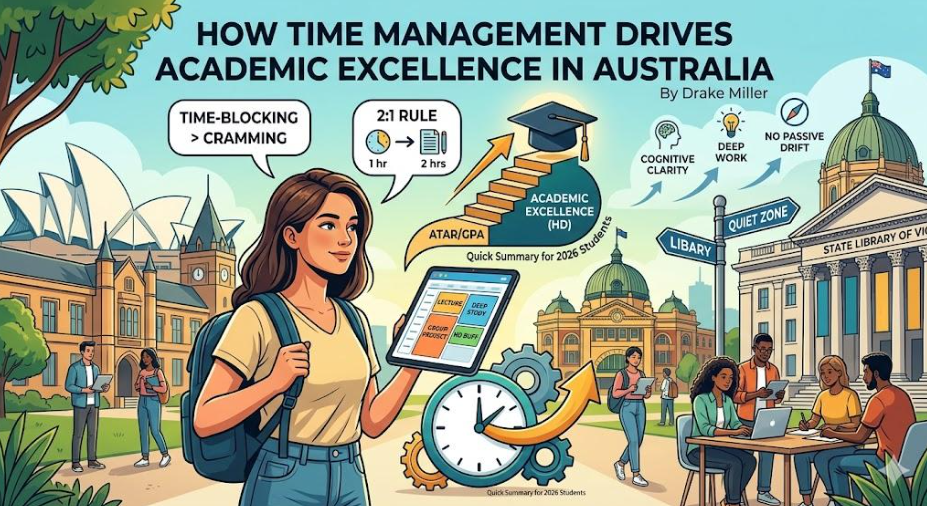
Effective time management moves a student from a “reactive” state—cramming late at night in a campus “Quiet Zone”—to a “proactive” state. Research aligned with the Tertiary Education Quality and Standards Agency (TEQSA) indicates that structured study habits lead to:
- Cognitive Clarity: By planning ahead, you eliminate the “stress of the unknown,” allowing the brain to focus entirely on the complexity of the task.
- Deep Work Capacity: Allocating undistracted blocks to tackle intense subjects like Advanced Mathematics, Australian Law, or Engineering.
- The “HD” Buffer: Completing work early allows for peer review and editing, which is often the narrow difference between a Credit (C) and a High Distinction (HD).
2. Strategic Framework: The Three Lenses of Planning
In Australia, the academic calendar is distinct, usually featuring two main semesters with a long summer break. To master this, students must view their time through three specific filters.
The Semester Macro-View
As soon as you receive your Unit Guides via Canvas or Blackboard, plot every deadline. In Australia, assignments are heavily “weighted.” If a Research Paper is worth 40% and a quiz is 5%, your time must reflect that weight. For students tackling high-stakes quantitative units, seeking specialized finance assignment help can be a strategic way to ensure these weighted tasks meet rigorous academic standards.
The Weekly Rhythm: Work-Life-Study
Australian students have one of the highest rates of part-time employment globally. A weekly schedule must account for:
- Contact Hours: Lectures, tutorials, and labs.
- Independent Study: The 2:1 rule (two hours of study for every one hour of lecture).
- Rest and Recreation: Essential for preventing burnout; whether it’s a coastal walk or a local footy match.
The Daily Deep Work Session
Utilize Time Blocking. Set a timer for 50 minutes of intense focus followed by a 10-minute “brain break.” This is vital for the heavy reading loads common in Australian Arts and Social Science degrees.
| Requirement | High School (Year 11-12) | University (Undergraduate+) |
| Schedule | Fixed (9:00 AM – 3:30 PM) | High variability; student-managed |
| Assessment | Consistent, teacher-monitored | Large, self-directed projects |
| Success Metric | ATAR Score | GPA / Professional Portfolio |
| Independence | Moderate supervision | Full accountability |
3. Professional Insights: Overcoming “Passive Drift”
In my years of consulting, I’ve noted that the most common cause of academic failure isn’t a lack of ability, but “Passive Drift.” This occurs when a student treats their degree like a hobby rather than a professional commitment. To excel in 2026, you must view your study hours as non-negotiable appointments. As AI tools begin to automate basic tasks, your value lies in your ability to manage high-level synthesis—a feat that requires dedicated, managed time.
4. Tips to Beat Procrastination for Australian Students
In Australia, the “special consideration” process for late assignments is increasingly rigorous. Relying on extensions is a “snowball” strategy that often leads to total burnout.
Tactics to Beat the Clock:
- Eat the Frog: Tackle the hardest task—like a complex coding problem or a legal case study—first thing in the morning.
- The 5-Minute Rule: Commit to working for just five minutes. Often, the psychological hurdle is simply starting the engine.
- Environment Design: Study in locations that promote focus, such as the State Library of Victoria or university “hubs” designed for collaborative quiet.
5. Integrating External Academic Support
The most successful students are those who act as project managers. They know when to seek help to keep their “project” on track.
For high school students aiming for a top-tier ATAR or university students struggling with dense modules, seeking expert assignment help at Myassignmenthelp.services can be a strategic decision. This isn’t about avoiding work; it’s about utilizing professional guidance to structure your thoughts, delegate formatting, and ensure your research meets Australian academic standards (including Harvard and AGLC referencing) while you focus on mastering the core concepts for your exams.
Additional Australian Campus Resources:
- Academic Skills Units: Free workshops on everything from Harvard referencing to time management.
- Peer Mentoring: Connecting with senior students who understand the specific demands of your faculty.
- Digital Ecosystems: Syncing deadlines via Notion, Trello, or Google Calendar across all your devices.
See also: Mastering the Gavel: A Data-Driven Guide to Academic Success for Australian Law Students (2026)
6. Active Learning: Maximizing Every Study Hour
Many students mistake “reading through notes” for studying. To maximize your limited hours, switch to active learning:
- Active Recall: Close your textbook and write down everything you remember about the lecture.
- Spaced Repetition: Review information at increasing intervals (1 day, 3 days, 1 week) to move it into long-term memory.
- Feynman Technique: Explain a complex Australian economic policy or biological process as if you were teaching a child.
7. Managing Group Assignments in the Professional Workforce
Group assignments are a staple of Australian education, designed to mimic the professional workforce. To manage them effectively:
- Set an internal deadline 48 hours before the official submission.
- Use collaborative platforms like Microsoft Teams to track real-time progress.
- Assign a “Project Lead” to ensure a single, cohesive voice in the final document.
Conclusion: Building a Professional Foundation
Mastering time management is a journey of trial and error. By valuing your time now, you are building the discipline required for a successful career in Australia’s competitive job market. Whether you are studying Medicine, Business, or the Creative Arts, your ability to organize your life is the foundation of your professional expertise.
Start small. Organize your workspace, sync your digital calendar, and remember that asking for help is a sign of a proactive, high-achieving student.
Frequently Asked Questions
Q.1 How many hours a week should an Australian student study?
The general guideline is 10 hours per week per 6-credit point unit. For a full-time load (4 units), that’s a 40-hour work week.
Q.2 How do I handle multiple deadlines on the same day?
Break each project into “micro-milestones.” Instead of seeing “Two Essays Due Friday,” see “Intro Essay A due Tuesday,” and “Body Essay B due Wednesday.”
Q.3 Is it possible to balance a part-time job and full-time study in Australia?
Yes, but transparency is key. Inform your employer of your exam dates early in the semester. Most successful students cap their work hours at 15–20 per week during peak periods.
Q.4 What are the best digital tools for Australian university students?
Digital tools like Notion for notes, Trello for project tracking, and university-specific portals (Canvas/Blackboard) for staying updated on Unit Guide changes.
About the Author: Drake Miller
Drake Miller is an academic consultant and senior content manager with over 12 years of experience in higher education strategy. Drake specializes in bridging the gap between student productivity and digital learning technology. His work focuses on the E-E-A-T (Experience, Expertise, Authoritativeness, and Trustworthiness) framework, ensuring that academic content serves the real-world needs of students in a fast-evolving, AI-integrated educational landscape.